
Simple, because there is no proof for that. Without proof or a logical explanation, we can claim anything. This is especially ironic in the case of Scytho-Sarmatians, as they are often considered to be the origin of the early Serbs and Croats – a Sarmatian tribe called Serboi was attested by Ptolemy in Northern Caucasia. If this theory of Albanians being Scytho-Sarmatian were true, Albanians and Serbs would have the same origin! While this is not the case, that would be some splendid historical irony.
There is a simple reason why Albanians are definitely no Scytho-Sarmatians in origin: We know what Scytho-Sarmatian languages looked like, as one is even alive today – Ossetian. They share no resemblance or linguistic continuity to Albanian whatsoever. We might as well call Albanian Celtic, Germanic or Baltic. And while most Scytho-Sarmatians (like the early Serbs) have been assimilated into Slavs, there is nobody that could’ve assimilated the Scytho-Sarmatians into using the Albanian language. So to conclude, there is no possibility of this theory being true, which can be seen by how no scholar (outside Serbia?) would claim that. Not a single one.
Meanwhile, all relevant modern scholars that have focused on the origin of the Albanians have concluded that Albanian is Paleobalkanic. This information may be hard to swallow for a few nationalists from Serbia etc.; This can be seen by how vehemently some (!) Serbs argue about Albanian origins (without actually caring about history of Albanians). But that doesn’t change the truth. History is history and should be kept out of politics. The possible ancestors of Albanian are the Illyrian languages and the Daco-Thracian languages, these are the two only possibilities that are still being discussed today. The Illyrian origin seems far more likely and is supported by most modern scholars and scientific institutions that discuss the Albanian origin, while the Daco-Thracian theory is being rejected by multiple scholars, as Thracian grammar doesn’t seem to resemble Albanian grammar, which would be a necessity for a continuity between the two. Scholars like the Oxford Professor of History, Noel Malcolm, link the Albanian origin to the ancient area of Dardania, as that was the only region in the Balkans where Illyrian-Thracian and the Proto-Vlach languages may have coexisted for a while, explaining the significant linguistic links between Romanian and Albanian today. Again, some will probably oppose this explanation solely due to political bias, but that’s how it is.


Before the medieval Slavic migrations, all the Paleo-Balkanic peoples were busy being extensively Romanized and Hellenized to the point of ceasing to be distinct from the Greeks and Romans.
If the Albanians descend from indigenous Paleo-Balkanic populations, why do they not speak a Romance or Hellenic language, like even the Romanians (descended from Dacians) do?
Keep in mind that the Albanian language has an izafet, something without precedent in any of the Paleo-Balkanic languages, but with much commonality to the Iranic languages.
Interestingly, several Sarmatian groups, such as the Iazyges and the Roxolani, have made their way to the Balkans in the distant past…
You are missing something here; Albanians were romanized. 60% of Albanian vocabulary today is of Latin origin. Albanian is a partly romanized language. The difference to other Paleobalkanic peoples is that Albanian was, similar to the Basques, never fully assimilated due to geographical circumstances. The North Albanian, South Montenegrin and Western Kosovar mountains are called ‘Accursed Mountains’ for a reason – they are very inaccesible, and serve as the ideal protection from full assimilation.
Now the Izafet is interesting, but isn’t nearly enough to prove a substantial connection between Albanian and Iranic languages. Especially since the Albanian izafet is izafet-like, but not identical to the construction of Iranic languages. The thing is simple: If Albanian was Iranic in origin, it would have already been proven by linguistic comparison. Albanian would be somehow similar to Iranic, Ossetian, Kurdish etc. But it isn’t. The ‘closest’ languages to Albanian are the Balto-Slavic and Germanic language families, not the Iranic one.
And about the Scytho-Sarmatian tribes in the Balkans. They are surely interesting, but why would you try to construct a theory about Iranic tribes in the Balkans when there was an attested Illyrian tribe called ‘Albanoi’? I mean, the Illyrians are the most obvious choice of Albanian ancestors, simply due to their proximity and due to toponyms and etymologies of Albanian and Illyrian names being related. While it is not yet proven beyond a doubt, it is highly unlikely that South-Illyrian tribes are not in some way the main ancestors of Albanians.

Albanian and Romanian were once the same language but while Albanian kept its originality (for the most part) Romanian got fully romanized.
But plenty of words are still recognizable especially the way they sound, it sounds almost identical to Albanian which means that both Countries had once contact before Slavs came
Artan Doda’s answer to What are some of the similarities between Albanian and Romanian language?

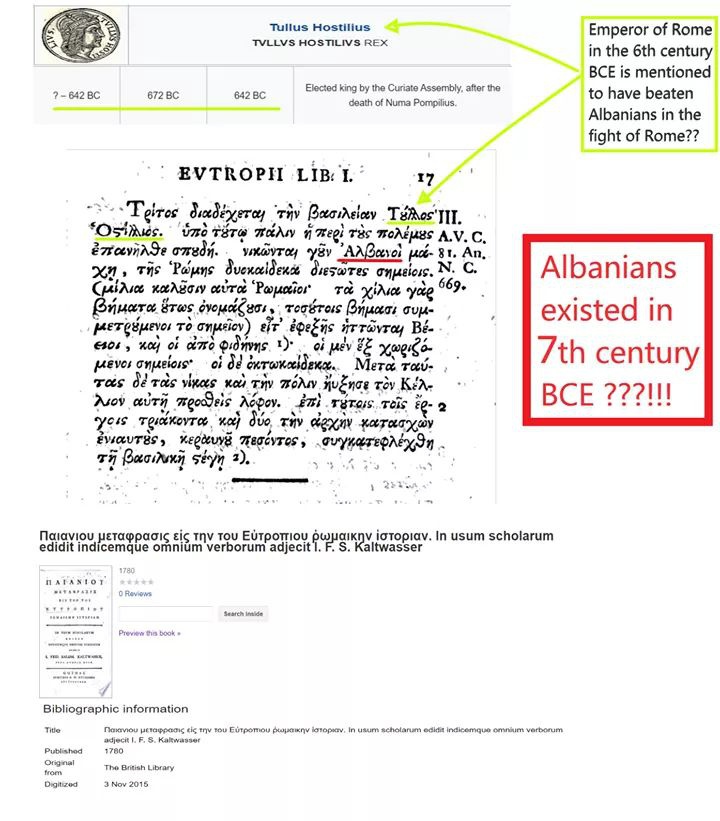
one evidence of albanians existence the Roman empire found us here in Balkan today were still Albanians the decendants of glorified illyrians are living, being so much resistance given from the barbarous Slavic people and from.ottoman empire the ones the worst ones.
Isn’t it rather bigoted to call an entire people “barbaric”?
Have you check the history of war’s in Kosovo / Albanian region (Albanians never occupied any country, but they got occupied on the most barbaric way by Serbs and different EU-Agreements through out history).