OSIRIS


| Osiris | ||||
| Egyptian deity | ||||
|---|---|---|---|---|
 Osiris wearing the Atef crown and the attributes of royalty |
||||
| Characteristics | ||||
| Other names | Ousir, Ounennéfer, Khenty-Imentyou | |||
| Name in hieroglyphics |
|
|||
| Hannig Transliteration | Wsjr | |||
| Representation | Mummified man | |||
| Divine group | Great Enneade of Heliopolis | |||
| Parèdre | Isis | |||
| Worship | ||||
| Region of worship | Ancient Egypt | |||
| Temple (s) | Abydos | |||
| Main place of celebration | Heliopolis | |||
| Symbols | ||||
| Attributes | Postiche beard, Heqa scepter, Nekhekh, Atefcrown, Jed pillar | |||
| Color | Black (representing death) Green (representing rebirth) |
|||
Change  |
||||


Osiris (from ancient Greek Ὄσιρις)is a god of the Egyptian pantheon and a mythical king ofancient Egypt. Inventor ofagriculture and religion,his reign is benevolent and civilizing. He drowned in the Nile, murdered in a plot organized by Seth, his younger brother. Despite the dismemberment of his body, he finds life through the magical power of his sister Isis. The martyrdom of Osiris earned him the world of theafterlife, of which he became the ruler and supreme judge of the laws of Maât.
In the Middle Kingdom,the city ofAbydos became the city of the god Osiris. It thus attracts many faithful in search of eternity. The fame of this city rests on its cult festivities of the New Year and on a holy relic, the head of the god.
During the first millennium BC, Osiris retained his status as a funerary god and judge of souls. However, his aspects of god of the Nile waves and, by the same to speak, of god of fertility, acquire primacy, thus increasing his popularity with the Nilotic population. Greek settlers settled in Memphis adopted his cult as early as the 4th century BC in its local form of Osiris-Apis, the dead and mummified sacred bull. The lagid rulers import this cult to their capital Alexandria in the form of Serapis,the Greco-Egyptian syncretic god. After the conquest of Egypt by Roman forces,Osiris and Isis were exported to Rome and its empire. They remained there, with ups and downs, until the 4th century AD and were finally ousted by Christianity (a ban on paganism as a result ofThessaloniki’s edict). The Osirian cult, active since the 24th century BC, lasted until the 6th century AD, when the temple of Isis on the island of Philo,the last of Egypt, closed around 530, the last ofEgypt,which was closed by Emperor Justinian.1.
Introducing[modifying | change the code]
Etymology[modifying | change the code]
| Osiris | |||
|
|||
| Wsjr |
Theorym Osiris is a transliteration into the Latin alphabet of a word from ancient Greek: Ὄσιρις which itself originates from a word of the Egyptian language: Wsjr variablely transliterated according to the authors by Asar, Asari, Aser, Aser , Ausar, Ausir, Wesir, Ousir, Ousire or Ausare,the Egyptian pronunciation of origin is not known becauseEgyptian hieroglyphic writing does not restore all vowels. Several Egyptologists have tried to give meaning to theonyma Osiris. In 1980, John Gwyn Griffiths proposed that Wsjr drift from Wser and mean “the Mighty.” Moreover, one of the oldest attestations of the god Osiris appears in the mastaba of the deceased Netjer-ouser (God-powerful). In 1987, Wolfhart Westendorf proposed Waset-jret etymology: “the eye-pointer.” In 1985, David Lorton hypothesized that Wsjr was a compound word from the morpheme set associated with jret; set-jret meaning “ritual activity.” Osiris would then be “The One who benefits from ritual activity”2. According to the Egyptian vision, destructive forces are in perpetual struggle against positive forces. In this, Seth opposes his brother Osiris, symbol of fertile and nourishing land.
First certificates[modify | change the code]

False gate of the tomb of Ptahchepsès – British Museum
Osiris is one of the main deities of the Egyptian pantheon. However, the origins of his cult are still very obscure. In the state of Egyptological knowledge, the earliest evidence of Osiris dates back to the 24th century BC and dates from the end of the 4th or early 5th dynasty. Osiris’ name is first found in an offering addressed to Osiris and Anubis by a likely daughter of Khephren,Hemet-Rê, royal daughter and priestess ofHathor. She probably died during the reign of King Chepseskaf,the last ruler of the Ivy Dynasty. The inscription appears on the lintel of the entrance to his tomb located in Giza3.
The first representation of Osiris is lacking, because it appears on a fragment of the high temple of King Jedkarê Esis. The god figures as a male character wearing a long divine wig4.
Another of these ancient archaeological evidence is an inscription of the name of Osiris on the lintel of the tomb of the high priest Ptahchepsès. The latter died during the reign of King Niouserrê. Discovered in Saqqarah the great necropolis of Memphis, the lintel is now preserved by the British Museum in London5.
The Pyramid Texts contain litany and incantations recited during royal funeral ceremonies. These texts are engraved on the walls of the burial chambers from King Ounas, the last member of the Fifth Dynasty. With this documentation, it is hardly possible to deduce where and when the Osirian cult appeared. Chapter 219, however, evokes various places of worship located in several cities in the Nile Valley including Heliopolis, Bousiris, Bouto, Memphis and Hermopolis Magna. Strangely enough, Abydos is not mentioned in this list6. The cult of Osiris was introduced to this city during the 5th Dynasty. Abydos is for the Osirian cult the most important place of pilgrimage from the Middle Kingdom. The Texts of the Pyramids mention that the body of the murdered god was found lying near the banks of the Nile in Nedit (or Gehesti), a territory close to Abydos7.
Archetypes and associations[modifying | change the code]
According to Egyptologist Bernard Mathieu,the appearance of the god Osiris was the result of a royal decision, as its cult suddenly spread throughout Egyptduring the early days of the 5th Dynasty.8. Its name is a voluntary graphic game based on the hieroglyphic depicting the throne. From the outset, Osiris is thus linked to the goddess Isis,the name of the latter meaning the throne. Osiris is the king of the funeral estates and the judge of the deceased. Its representation is anthropomorphic,far removed from the animal forms that can be taken by other deities from the predynastic period(bovids, crocodiles, falcons)9. The Osirian dogma is elaborated by the clergy ofHeliopolis under the control of the monarchical power that is responsible for spreading it throughout the country, probably to better establish its ascendancy on the great temples like those of Bousiris,Abydos orHeracleopolis10.

Osiris is associated with other deities. In Lower Egypt,in Bousiris,he absorbs the qualities ofAndjety,the guardian god of this town from prehistoric times11. The representation of this shepherd god is characterized by his two high feathers on his head, held by a long headband, with in his hands the scepter Heqa and the flagellum Nekhekh12. Osiris is also likened to the funeral god Sokar who watches over the memphite necropolis. This god is represented by the association of a man’s body, which is sometimes sheathed in a shroud,and a falcon head and very often without any distinctive sign. It is also sometimes depicted as a mummified falcon13. In Upper Egypt,Osiris established itself in particular in the name of the Great Earth,the region surrounding the city of Thinis,the oldest capital ofancient Egypt14. This ancient city is still not located with certainty. It is known, however, that Osiris was close to the god Onouris15. This god is a bearded man who wears a headdress consisting of four high feathers. Onouris, in his funerary aspect, carries theepithet of Khentamenti, the “Chief of the West”16. The thinite necropolis was located in Abydos. There, Osiris assimilates to Khentamentiou,the “Head of the Westerners”, a funeral deity close toOupouaout and represented in the form of a black canid.
Representations[change | change the code]
The god Osiris is intimately linked to the Egyptian monarchy. The god is seen as a dead king and then deified. Its attributes are thus those of the Egyptian rulers. Osiris was considered a ruler of the whole of Egypt. However, his representations show him only with the white Hedjet crown, symbol of Upper Egypt. This crown comes in the form of a cap narrowing upwards and ending with a bulge. However this crown can be increased by two high lateral feathers, probablyostrich,we are then called the Atefcrown. His other royal symbols are the Heqa scepter and the Nekhekh flagellum, which he holds in his hands crossed on his chest. Osiris being a dead god, his representations make him see as a mummified body. His postures are various, lying on his funeral bed, sitting on the throne or standing like a being who has conquered death17.
-

Deceased Osiris surrounded by his winged sisters. Temple of Denderah.
-

Osiris sitting on his throne. Book of the Dead of Padiamonet, XXIIe Dynasty
-

Osiris standing surrounded by two nebrides. Tomb of Sennedjem, 19th Dynasty.
.jpg?uselang=fr)


 Click on a thumbnail to enlarge it.
Epithets[modify | change the code]
Osiris est un dieu complexe dont la présence est attestée sur tout le territoire égyptien. Ce dieu regroupe en son sein plusieurs facettes. Ses aspects de dieu funéraire sont bien connus. Mais Osiris est aussi une divinité qui veille au bon fonctionnement de l’univers. Son action bienfaisante est ainsi à l’œuvre dans le défilé des étoiles ou dans le cycle saisonnier de la végétation18. Therefore, Osiris introduces himself to his worshippers under a multiplicity of names. Litanies are chanted to “Osiris under all its names.” Early on, Osiris was given the epithet “He who has many names”(ash renou). This accumulation of epithets and names appears in chapter 142 of the Book of the Dead. This text allows the deceased to access eternal life in the image of Osiris. To do this the deceased lists a list of one hundred and fifteen epithets attached to the name of Osiris. The more names the faithful list, the more he recognizes and accepts the power of the invoked deity19. The different functions of the god and the different cities where his worship is present are intertwined, without logical order:

Theophore statue of Psammetics, XXVIe dynasty, Louvre Museum.
Osiris Ounennéfer,
Osiris
alive, Osiris master of life,
Osiris master of the Universe, (…),
Osiris who presides over the grain,
Osiris
Orion, (…),
Osiris master of millions of years,
Osiris soul of the two ladies, Osiris-Ptah master
of life,
Osiris who presides over Ro-Sétaou, Osiris regent of the shores, who resides in Bousiris, (…),
Osiris in his palace in Ro-Sétaou, Osiris in theAbydosregion, Osiris in Nedyt, Osiris who presides over his city, Osiris the sovereign,
(…), Osiris in the sky, Osiris in the earth, Osiris in the earth, Osiris in the earth,
Osiris
Osiris who governs eternity in Heliopolis,
Osiris begeter, Osiris
in the boat of the
night, (…), Osiris who presides over the West, Osiris in all its places, (…)
— Excerpts from chapter.142 of the Book of the Dead. Translation by Paul Barguet20
Birth and family[change | change the code]
Osiris, the son of Nout[modifying | change the code]

Osiris’ parents, Nout (heaven) and Geb (earth) were separated by Shou (vital breath) on the order ofAtum (creator god). Detail of the Greenfield Papyrus or Book of the Dead by Nesytanebetisherou of the British Museum.
The Greek Plutarch is the author of several treatises on morality, philosophy and theology. The treaty On Isis and Osiris refers to Egyptian beliefs. This author is the first to summarize and expose the Osirian myth into a linear narrative. The story begins with the mythical introduction of the 365-day solar calendar. Nout,the goddess of heaven, has maintained a secret romantic relationship with Geb, her brother, the god of the earth. Ra,the sun god, upon learning of these acts, gets angry and forbids Nout to give birth during the days of the year. Thot, Nout’s other brother, decides to play dice with the Moon to earn him a seventy-twelfth of his days of light. Having won five more days, he places them after the 360 days created by Ra. Osiris was born on the first day, Horus the Elder on the second day, Seth on the third day tearing the mother’s womb, Isis on the fourth day in the marshes of the Nile Delta and Nephtys on the fifth and final day. Plutarch adds that the true father of Osiris and Horus the Elder would be Ra, that Isis’ father would be Thot and that only Seth and Nephtys would be the descendants of Geb. But it also indicates another version of the fatherhood of Horus the Elder. Even before they were born, Osiris and Isis, in love with each other, would have conceived Horus the Elder in their mother’s womb21.
Chapter 219 of the Pyramid Texts magically equates the deceased pharaoh with Osiris, the god who has been restored to life. All the gods of the Osirian family are encouraged to restore the dead king to life as they did for Osiris. In this chapter are mentioned the different family ties that the gods ofHeliopolis maintain between them. Osiris is the son ofAtoum, Shou and Tefnout,Geb and Nout.22. Other texts make us understand that Atoum created Shou and Tefnout and that these are the parents of Geb and Nout23. The enumeration of family ties continues by mentioning Osiris’ siblings, saying that his siblings, Isis, Seth, Nephtys and Thot, and thatHorus is his son24.
Osiris, the beloved of his sisters[modify | change the code]
Isis[modifying | change the code]

Representation of WingedIsis engraved on the sarcophagus of Ramesses III, XXdynasty. Louvre Museum.
Isis was considered by the ancient Egyptians as the wife of the god Osiris. As such, his cult became very popular, especially during the years of the Lower Era. When the cult of the Egyptian gods began to perish in their country of origin, the veneration of Isis, the grieving widow who saves the initiates from death, continued outside the borders of Egypt, Greece (Athens, Delphi, Corinth), Italy (Rome and Pompeii)or Germania (Mainz). Osiris (or his Greco-Roman form of Sarapis)was of course always associated with him, but the wife eclipsed the husband in the hearts of devotees25.
The Amenmes funeral stele(18th Dynasty),now in the Louvre Museum,is the most comprehensive Egyptian archaeological document about the Osirian myth. You can read a hymn to Osiris. Of course, passages are devoted to his grieving wife. Seth murdered Osiris and then made the body disappear. Isis, by the power of its magic, revives Osiris the god with a failing heart. Then, after joining him, she conceives Horus as the future heir to the throne:
“Her sister makes her protection, she who drives away the opponents. She repels the occasions of disorder by the charms of her mouth, the expert in her language, whose speech has no failure, perfect in her orders. Isis, the Efficient, the protector of her brother, seeking him without weariness, traveling this country, in mourning, does not rest that she has not found him. In a shade with her plumage, producing air with her two wings, making gestures of joy, she makes her brother approach; pointing out what was sagging for the one-whose-heart-defeat; extracting her seed, creating an heir, she breastfeeds the child in the solitude of an unknown place, inducts him, her arm become strong, in the Great Hall of Geb. »
— Grand Hymn to Osiris (C286 stele of the Louvre Museum)26.
Nephtys[modify | change the code]

Representation of winged Nephtys engraved on the sarcophagus of Ramesses III, XXdynasty. Louvre Museum.
In his treatise, Plutarch mentions that Osiris, out of contempt, deceived Isis and that this infidelity was committed with his twin sister Nephtys, Seth’swife. From this adulterous relationship was born Anubis, the canid-headed god27. A paragraph of the Papyrus Brooklyn (XXVIe dynasty) mentions that in the city of Letopolis there is a statue depicting Nephtys in the form of the lioness Sekhmet embracing the mummy of Osiris28 ; attitude that is more that of an official wife than a mistress. This fact is confirmed by two scenes from the temple of Edfou where Nephtys bears the name Of Anophret. This name makes Nephtys the feminine counterpart of Osiris in its appearance ofErnennefer (the perfect existence). In one scene, Nephtys protects Osiris’ mummy after giving him back his head and life. In addition, the name of the goddess is inscribed in a cartridge which makes her a legitimate wife29. Isis must then be regarded as the earthly wife of Osiris and Nephtys as his eternal wife, the one who accompanies him into the afterlife. Plutarch writes about The two sisters of Osiris: “Nephtys, in fact, refers to what is underground and what is not seen; Isis, on the contrary, what is on earth and what we see »30. Nephtys was the nanny of the young Horus. She protected him from Seth’s fury by hiding him in the swamps of Khemmis. In exchange for this protection and to escape Seth’s vengeance, she won the favor of being with Osiris in the underworld:
“Remember what I did for you, (my) child: Seth, I kept him away from you, I nursed you by carrying you and having milk. You were saved in the Khemnis affair, for I refused to recognize Seth’s face because of you! Give me one hour, so I can see Osiris because of what I’ve done for you! »
— Excerpt from the Papyrus of Imouthès. Translation by Jean-Claude Goyon31
Mythical Egyptian sovereign[modifying | change the code]
Osiris inducted him[modify | change the code]
_-_front_-_TIMEA-6.jpg?uselang=fr)
Osiris momiform sitting on his throne (photograph of 1881).
TheEnneade of the Gods ofHeliopolis was considered by the ancient Egyptians to be the first dynasty of their rulers. After creating Egypt, Atoum–Rae ruled the country, then was replaced by Shou and then by Geb. The latter, noticing the merits of Osiris, left him the throne:
“[Osiris] firmly establishesorder throughout Egypt. He places the son on the throne of his father, praised by his father Geb, loved by his mother Nout […] heir to Geb for the royalty of the Double Country. As he saw his perfection, he ordered that he guide the country for a happy success. »
— New Empire Osiris Anthem (C286 stele of the Louvre)32.
A scene from the temple of Denderah engraved in the 1st century BC informs us that Osiris, like the human pharaohs, has benefited from a royal title composed of five names and based on a theological wordplay33 :
- Horus name: vigorous (wsr) arm
- Nebty’s name: vigorous (wsr) by valour
- Golden Horus Name: Osiris (wsjr)
- Nesout-bity name: Osiris (wsjr)
- Name of Sa-Rê: triumphant Ernennéfer.
Chapter 175 of the Book of the Dead indicates that the god was crowned in the city of Heracleopolis Magna by the creator god Atoum–Ra. The coronation of Osiris provides the occasion for a dialogue in which the creative verb of the two deities engenders mythical facts and places of Egyptian theology; below the sacred basins of the Temple of Heracleopolis:
“Then Osiris had a headache, because of the warmth of the crown-Atef, which was on his head (the first day he had placed it on his head) so that the gods would be afraid of him. Then He returned in peace to Heracleapolis to see Osiris, and he found him sitting in his house his head having become swollen because of the heat of the crown. Then Ra drained this blood and the sanie of this abscess, and they became a pond. Then Ra said to Osiris, “See, you have formed a pool of blood and sanie that have flowed from your head.” “Hence this sacred pond at Heracleopolis. »
— Excerpt from Chapter 175 of the Book of the Dead. Translation by Paul Barguet34.
Osiris, Lord of Maât[modify | change the code]

Statuette depicting Sethi I offering Maât to the Gods(19th Dynasty). Collection of the Louvre Museum.
Plutarch reports that Osiris taught his people civilized ways so that men would no longer look like wild beasts. He taught them agriculture and respect for the gods and laws35. The earliest Egyptian archaeological documents concerning Osiris confirm Plutarch’s claims. A fragment of an architrave of the Fifth Dynasty tells us that, from his cult beginnings, Osiris is named “the great god, lord of Maât, Osiris who presides over Busiris and in all its places”36.
The Maât (cosmic order) is a political-religious concept that appears during the formation of theOld Empire. At that time, the Egyptian king took on a central dimension. In a unified country, his person exceeds all local authorities. In this context, the Maa is a myth that allows to unify all the subjects of the Egyptian sovereign under one authority. The Maât was then the deification of the will and the royal order. To say and make the Maât is to obey and participate in the monarchy37. In social life, to participate in the Maât means to participate actively and reciprocally in a necessary human solidarity, anti-Maât behaviour being laziness38, mental deafness39 and greed40.
At the greatest moments of the kingship of theOld Empire,the Maât is a typical attribute of the human king. This is the case with the rhomboid pyramidbuilder, King Snefrou (IVdynasty). In his titulature,this sovereign establishes himself as “Lord of Maât”41. The political-theological situation changes with the Fifth Dynasty. The supreme power passes from the earthly world to the divine plane. The king’s power devalued and the rulers of this dynasty became the “sons of Ra”42. At the same time, the sovereigns were also stripped of their authority over the Maat in favour of Osiris. By the same to the end of human life, the Maât becomes sacred because it is entrusted to the ruler of the afterlife, who punishes at the end of human life all harmful acts. Kings are no more than executors who make and say the Maât43. A passage fromthe teachings of Ptahhotep shows us that the Egyptian scholars linked the establishment of the Maat to the mythical reign of King Osiris:
“The maât is powerful, and of perpetual efficiency of action. It cannot be disrupted since Osiris’ time. Punishment is inflicted on those who break the law. This is what escapes the attention of the greedy. »
— Teaching Of Ptahhotep. Excerpt from Maxime 544
Murder and Rebirth[modifying | change the code]
Pyramid texts[modify | change the code]

Osiris, Anubis and Horus. Tomb of King Horemheb, 19th Dynasty
The brutal death of the god Osiris and the magical process of its rebirth are mentioned several times in the Texts of the Pyramids. Chapter 670 is a funeral recitation in which these main moments of the Osirian destiny appear. Two kings benefited from this ritual text. These are Pepi I and Pepi II of the 6th Dynasty. They ruledEgypt in the 21st and 21st centuries BC. In both cases, the text is engraved on the southern wall of the burial chamber as close as possible to the sarcophagus45. Recitation does not present itself as a narrative or as a structured story; this genre appears only with the philosopher Plutarch. The recitation is a magical incantation that makes the late king play the role of Osiris.
The recitation can be divided into two sequences. The first evokes the martyrdom of Osiris. The gates of heaven open to let the gods pass the city of Pe,a locality located in Lower Egypt. No doubt it’sHorus and his two sons Amset and Hâpi. The gods come to the body of Osiris, attracted by the lamentations ofIsis and Nephtys. In mourning and in honor of the deceased, they hit each other’s thighs, ruffled their hair, beaten hands while denying Osiris’ death. They urge him to wake up so that he can hear what Horus has done for him. He’s told his murder is avenged. Seth had struck and killed Osiris as a simple bovid and then tied him up. Horus informed his father that he had inflicted the same fate on Seth and then placed him in the custody of Isis46. The rest of the recitation traces the rebirth of the god Osiris. In the lake of life,the deceased takes the form of the jackal god Oupouaout. Horus offers his father his defeated Sethian enemies. These are brought by Thot. Then the son enthrones the father as the leader of the deceased by giving him the scepter Ouas. After being purified by Nephtys,Osiris is scented by Isis. It seems that Seth also skinned his brother because it is then mentioned that the two sisters have gathered his flesh and attached his limbs. His eyes are given back to him in the form of the boats of the day and night (Sun and Moon). Horus’ four children participated in osiris’s recovery. To make him completely calmed down, we proceed on him to the ceremonialopening of the mouth. Awakened to life by Shou and Tefnout,Osiris leaves the Douât and climbs towards Atoum towards the heavenly fields47.
Plutarque[modifier | modifier le code]

Isis transformée en milan s’accouple avec la momie d’Osiris. Relief du temple funéraire de Séthi Ier (Abydos), XIXe dynastie.
La plus récente version du mythe nous fut transmise par Plutarque. Ce philosophe grec fait d’Osiris et d’Isis des souverains bienfaiteurs. Osiris enseigna aux humains les rudiments de l’agriculture et de la pêche, tandis qu’Isis leur apprit le tissage et la médecine. Pendant ce temps, Seth régnait sur les contrées désertiques et hostiles ainsi que sur les terres étrangères. Jaloux de son frère, Seth projeta l’assassinat d’Osiris pour s’emparer du trône d’Égypte qu’il convoitait. Pendant un banquet en l’honneur d’Osiris, Seth offrit à l’assistance un magnifique coffre, jurant de le céder à celui qui l’emplirait parfaitement en s’y allongeant. Aucun de ceux qui tentèrent l’exploit ne parvinrent à remporter le coffre. Quand vint le tour d’Osiris, qui fut le seul à y parvenir, Seth fit refermer et sceller le coffre, tandis que ses complices chassaient les invités et tenaient Isis à l’écart… Seth jeta le coffre dans le Nil, qui l’emporta dans la mer Méditerranée. Osiris noyé, Seth profita du meurtre pour asseoir sa domination sur l’Égypte. Isis, la veuve éplorée, rechercha alors à travers toute l’Égypte le corps de son mari et le retrouva à Byblos, au Liban. Elle ramena la dépouille du roi assassiné en Égypte et se réfugia dans les marais du delta du Nil. Au cours d’une chasse nocturne dans les marécages, Seth retrouva le corps haï de son frère. Il entra dans une rage folle et découpa le défunt en quatorze morceaux qu’il dispersa dans toute l’Égypte. Aidé de quelques fidèles dont Thot, Nephtys et Anubis, Isis retrouva les parties du dieu, hormis son pénis avalé par le poisson oxyrhynque. Après en avoir reconstitué le corps, elle procéda à son embaumement avec l’aide d’Anubis en l’enveloppant dans des bandelettes de lin. Le corps du dieu restant inerte, avec l’aide de sa sœur Nephtys, Isis bat des ailes en poussant des cris stridents pour insuffler la vie à Osiris grâce à ses pouvoirs magiques. Ranimé, Osiris ne revient pas sur terre, mais règne désormais sur le royaume des morts. Ainsi, la renaissance d’Osiris annonce toutes les formes de renouveau possibles, que ce soit dans la végétation ou chez les humains. Transformée en milan, Isis peut être fécondée. De cette union naît Horus l’Enfant (Harpocrate), qu’elle cacha dans les fourrés de papyrus du delta pour le protéger de son oncle Seth48.
Pilier-Djed et rituels de régénération[modifier | modifier le code]
Le pilier Djed est un très ancien fétiche attesté à Hiérakonpolis dès l’époque thinite dans le cadre d’un culte rendu à Sokar ; un dieu funéraire représenté sous la forme d’un faucon momifié. La signification d’origine de Djed n’est pas encore connue. Peut-être s’agit-il d’un arbre ébranché. Mais dès ses débuts, ce pilier fait aussi partie des rites agraires de la fertilité du grain. À Memphis, le pilier Djed était d’abord érigé en l’honneur de Ptah et Sokar. Au début du Nouvel Empire, Osiris se fond avec ces deux dernières divinités sous la forme de Ptah-Sokar-Osiris. L’érection du pilier Djed symbolise alors la victoire d’Osiris sur Seth49. Dans ce cadre, le Djed est vu comme l’épine dorsale d’Osiris. Cette vision du Djed apparaît aussi dans le Livre des Morts. Le jour de l’enterrement, une amulette Djed est placée au cou de la momie :
« Redresse-toi, Osiris ! Tu as (de nouveau) ton dos, (ô) toi dont le cœur ne bat plus ; tu as tes vertèbres, (ô) celui dont le cœur ne bat plus. Mets-toi sur ton côté, que je mette l’eau sous toi ! Je t’apporte le pilier Djed en or ; puisses-tu en être réjoui ! »
— Chapitre 155 du Livre des Morts. Traduction de Paul Barguet50
-

Amulet Jed in the name of King Ramses IX. Louvre Museum
-
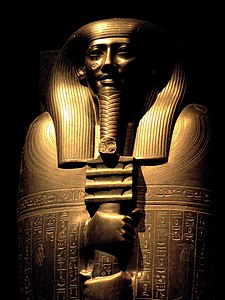
Ibi’ssarcophagus. Egyptological Museum of Turin
-
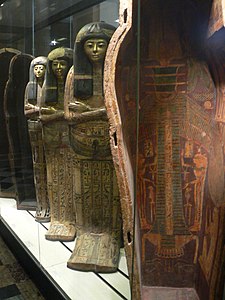
Sarcophagus background with a Jed osirianized pillar. Louvre Museum.
.jpg?uselang=fr)


From the New Kingdom,the Jed pillar was anthropomorphized and its representations were similar to those of Osiris. On the reliefs of the funerary temple of Sethi I,the Jed pillar as a resurrected Osiris comes to life and comes back to life after being righted by Pharaoh Ramses II. There, the rite of the erection of the Jed pillar is to give life to the god Osiris. The Jed pillar is equipped with two Oudjateyes, different crowns (including the one consisting of two high ostrich feathers) and is covered with the royal loincloth. In hieroglyphicwriting, Jed is the sign of stability. In the ritual ofAbydos,this notion of stability refers to the necessary cohesion of the Double Country formed by the union of Upper and Lower Egypt51.
-

Ritual of the erection of the pillar Djed. Osiris Chapel of the Temple of Sethi I.
-

Detail.
-
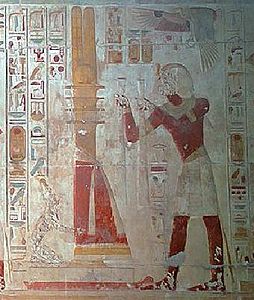
Detail


Cosmic divinity[modifying | change the code]
Osiris encircling the Douât[modify | change the code]
Douât[modify | change the code]
The Douât is a mythical place that has no precise geographical location. This place is sometimes located in the sky, but other times on earth. The translations of Egyptologists make it one beyond or a hell. However, the Douât does not really correspond to these two concepts. In ancient Egyptian,the root of the word love is close to the verb douâ which means “pray, worship.” As for the word sweet,under another spelling, it can also mean “praise, hymn, adoration.” In addition, the word “douou” means “dawn, morning and dawn.” As for the planet Venus, it is either the douou netjer (god of the morning), or more simply Douât. The region of the Douât is thus a junction point where the living and the dead can praise the rebirth of light when the nocturnal darkness disappears in the face of the rebirth of the sun at dawn52.
| Name | Transcription | Hieroglyph | Translation | ||||
|---|---|---|---|---|---|---|---|
| Douât | dw3t |
|
Beyond | ||||
| douâ | dw3 |
|
Pray | ||||
| douât | dw3t |
|
prayer, praise | ||||
| Douât | dw3t |
|
planet Venus |


Nocturnal regeneration[modifying | change the code]
In the New Kingdom a new kind of funeral literature was created; “Books of what is in the Douât.” These works are intended for royal personalities and appear on the walls of their tombs, cenotaphs or sarcophagi.

Final table of the Book of Doors. Based on the sarcophagus of King Sethi I kept at Sir John Soane’s Museum in London.
These texts, unlike the Book of the Dead,are not compilations of magic formulas of motley provenance. These are immutable texts that describe the rich illustrations associated with them. The oldest book is the Book of Amdouat, which appeared under Thutmose III. If the Book of Doors appears at Horemheb,the first complete copy appears on the sarcophagus of Sethi I. The twelfth and final sequence of this composition contains a representation of the moment when the sun comes out of the underworld to be reborn at dawn. This scene is an image of the cosmological thought of the Egyptians of the New Empire53
The god Noun seems to be coming out of the primordial waters. He raises the solar boat with his two long arms. On board, the Khépri beetle (symbol of rebirth) holds the solar disk. On either side of the beetle, the goddesses Isis and Nephtys seem to welcome or propel the reborn sun. The latter is received in the arms of Nout the goddess of heaven. Represented upside down, the goddess is standing on the head of Osiris whose body forms a loop that contains the Douât. The notice says: “It is Nout who receives Ra.”54.
Like the Ouroboros snake biting its tail, Osiris is curled up on itself. His body forms a circle and the notice says: “It is Osiris who encircles the Douât.” This representation of the god is a way of showing that time is cyclical. The circle symbolizes perfection and movement. This permanent return of things and events is a succession of regenerations. Osiris and Nout are depicted upside down to show that the Douât is not subject to the same rules as the ordained universe, the sun traveling from west to east. When the sun enters, it can only come out. In the evening, the sun enters the West. It regenerates during its time in the Douât. This world of night and death is ruled by Osiris. After crossing twelve regions and twelve portals, the sun is reborn at dawn as it rises from the eastern horizon. This exit from the underworld is symbolized by the second sun which is located at the bow of the solar boat. The sky through Nout is located between the Douât and the ordained universe. It is the link between the two worlds55.
Osiris, the lord of millions of years[modify | change the code]

The mortality of the Egyptian gods is often evoked in a cycle where death and rebirth alternate, the rejuvenation of the god being possible only through his death56. But egyptian documents that evoke the final end of time and the final disappearance of the gods are few and far between. Chapter 175 of the Book of the Dead, however, very clearly describes this situation57. At the end of time, only Atoum and Osiris will remain. Osiris laments having to stay in the world of the afterlife. Atoum consoles him by telling him that the desert of necropolises is his kingdom, that his son Horus reigns over men and that his lifespan is going to be very long. Atoum tells him that the two of them, alone, will endure by returning to the chaos of origins in the form of a snake:
“You are destined for millions of millions of years, a lifespan of millions of years. But I will destroy everything I have created; this country will return to the state of Noun,as its first state. I am what will remain, with Osiris, when I have turned again into a snake, which men cannot know, that the gods cannot see. »
— Book of the Dead,chap.175, excerpt. Translation by Paul Barguet58.
Osiris Orion[modify | change the code]
| SahOrion | ||
|
||
| Sȝḥ |

The Egyptians referred by Sah to the constellation ofOrion. Personified by a man wearing the white crown of Upper Egypt,Sah was considered the ruler of the stars whose race he ordered into the night sky. Sah is the soul-Ba d’Osiris or Osiris himself according to different traditions59. Several chapters of the Texts of the Sarcophagi are devoted to this constellation (chapter 469, 470, 689, 1017)60. Chapter 227 allows the deceased to become Osiris’ successor. The deceased, after claiming that he is Osiris, goes on to speak of Orion:
“I am Orion, the one who has reached his Double Country, the one who sails at the front of the frame of heaven [the stars] into the body of his mother Nout; she was fat with me according to her desire, and she gave me joy in her heart. »
— Excerpt from Chapter 227 of the Texts of the Sarcophagi. Translation by Paul Barguet61.
Osiris the beeur[modify | change the code]

Map of the constellationOrion.
Chapters 366 and 593 of the Pyramid Texts,very close in their writing, recount the birth and conception ofHorus. It appears that his parents are Osiris and Isis62 :
“Your sister Isis came to you, happy with your love. After you placed it on your phallus, your seed sprang into it.”
— Texts of the pyramids. Chapter 366.
The rest of the text has an astral dimension because the fruit of this union is Hor-imy-Sopedet, i.e. “Horus in the constellation of the Great Dog”. Osiris, likened to the constellationorion,transmits its stellar essence to Horus, the star Sirius through Isis, the constellation of the Great Dog.63 :
“Your seed sprang into it (Isis), piercing (soped) in Sopedet; Horus-Soped came from you in his name of Horus in Sopedet. »
— Texts of the pyramids. Chapter 593.
This mythical and astronomical birth is based on a series of theological puns: Soped Egyptian name of the star Sirius, means sharp, sharp, skilful, skill and Sopedet means triangle and efficiency. The star Sirius-Soped can then refer to one of the three points of the triangle that it forms with the stars Betelgeuse and Rigel, Sirius-Soped having a more important role because this equilateral triangle points towards it. Osiris-Orion is the god in lethargy; three stars form his phallus (currently seen as his belt)pointing to the constellation of the Great Dog: for the Egyptians, this one is Isis in the form of a bird, the kite,which carries within it his successor Horus-Soped(Sirius), the one who fights effectively to restore his father in his life and his royal duties64.
Funeral deity[modifying | change the code]
Osiris the leader of the Westerners[modify | change the code]
_-_front_-_TIMEA-7.jpg?uselang=fr)
Osiris standing, momiform and wearing the atefcrown. Photograph of 1881. Boulaq Museum
Dated from the reign of Ramesses V (XXdynasty), the chester Beatty I papyrus contains the tale of the Adventures of Horus and Seth. The story tells of the infighting raging within the Osirian family65. King Osiris is dead. For eighty years, Horus and Seth have been arguing over the succession to the throne. The Egyptian gods sit as jurors in a court presided over by Ra. They are divided into two camps of equal power. Horus, a teenager with little experience, is supported by a faction led by his mother Isis. As for Seth, valiant defender of the Solar Barque against Apophis,his cause is supported by Ra. If Horus is to face Seth’s magical onslaught, Seth must face those of Isis. After thousands of blows, the court gods are tired of the procrastination of the old Ra. His successive judgments are all in Horus’s favour, but each time Seth can challenge them because of his ascendancy over Ra66. On the advice of Thot and Shou,Ra sent a letter to Osiris to find out his opinion. In response, the deceased god puts forward its own merits:
“Why is my son Horus being harmed? I’m the one who made you strong. It was I who created barley and spelt to keep the gods alive, as well as the herds under the care of the deities. There was no god or goddess to do this. »
— The Adventures of Horus and Seth. Translation by Claire Lalouette67.
Unimpressed, He mocks Osiris’s power by saying that with or without him, barley and spelt would still exist. Angry, Osiris threatens the gods of theEnnead. In fear of an epidemic, the gods make a final judgment in favor of Horus. The final argument is that Osiris depends on the good health of creation. He feeds the gods and men as the god of abundance. But according to his good pleasure, he can unleash against his enemies and the ungodly an army of demons so that they shorten the joyful earthly life of living beings:
“This is really perfect, really perfect, everything you’ve created, O inventor of the Enneade! But justice has been brought to the fore in the underworld. Why don’t you take a look at it? This country in which I am is filled with ferocious-faced messengers, who fear no god or (no) goddess. If I take them out, they would bring back to me the hearts of all those who have committed vile acts, but they show up here in my company. And why do I spend my life here, in peace in the West, when you are outside, all of you? Who among them is stronger than me? But see, they made up the lie. And when Ptah . . . created the sky, did he not say to the stars there: “You will go to bed on the West, every night, where King Osiris resides? Then the gods, the nobles and the people will also lie down in the place where you are” – that’s what he told me. »
— The Adventures of Horus and Seth. Translation by Claire Lalouette67.
Osiris Ounennéfer[modify | change the code]
The ancient Egyptians did not see death as a natural thing. By identifying all the dead at Osiris, the murdered god, they conceived death as crossing a threshold between the earthly world and the world of the afterlife. Death is a transient crisis that can be solved by the funeral ritual. The court of Osiris symbolizes this crucial step because only one who is morally pure can claim the rites. Only the one who is free of sins appears before the osiris court68. This purity is emphasized from theOld Empire in the texts of tombs and mastabas. The gods, through the intercession of the king, grant the servants of the monarchy the status of Imakhou (grave possessor). But this privilege can only be claimed if the Maâthas been respected and applied. Osiris, in his name ofOunennéfer (Perfect Existence), is a model to follow, his exemplary life having led him to exercise royalty on earth and beyond:
“I have done justice for his lord, is that I have satisfied him in what he loves. I told the truth,I did justice, I said good, I repeated good, I attained perfection, because I wanted to have good with men. I judged two litigants so that they were satisfied. I saved the wretch from the one who was more powerful than him in what I had authority over. I gave bread to the hungry, clothes to the naked one, a passage to the shipwrecked, a coffin to the one who had no son. I made a boat for those who didn’t have a boat. […] »
“False door of Nefersechem,” Said Chechi69

Ani before Osiris, judge of the Afterlife. Ani Papyrus, 19th Dynasty.
In the New Kingdom,the judgment of the dead acquires its final form as it appears in the Book of the Dead (Chapter 125). The passage in front of Osiris and his forty-two assessors is more like an ordeal than a court proceeding. The deceased knows in advance what can be blamed for and defends himself by denying two lists of sins. A first list of forty fouls is denied in front of Osiris, then a second list of forty-two fouls is denied in front of the forty-two assessors who symbolize the entire Egyptian territory. These laws conditioned access to the world of theafterlife. But chapter 125 is more than a magic formula designed to purify the deceased. The Egyptian did not rely only on the power of magic to save his soul70. His post-mortem appearance before Osiris was accompanied, during earthly life, by a life inspired by the laws of the court:
“I am a nobleman who has come to know in Maât, who has taken the law of the hall of the two Maât as an example, for I intended to arrive in the necropolis without any meanness associated with my name, I have done no harm to men, nor anything that their gods prove.”
— Baki’s Funeral Stele, 14th century71
From Osiris-Apis to Sarapis[modifying | change the code]
The Apis bull (Hapi in Egyptian) symbolizes the cycle of a young animal succeeding an elder who has just died of natural death. As soon as a bull died, the priests searched for a bull that resembled him and then enthroned him. The succession of Apis is attested from Amenhotep III until the end of the Ptolemy dynasty but probably lasted until the 4th century AD. Apis conveys two theological images; first, the royal succession and second, the Osirian renaissance. Apis is thus depicted as a living and walking bull, as a dead and mummified animal and as a bull-headed human. The deceased Apis becomes an Osiris under the name Osiris-Apis (in Egyptian Osor-Hapi)72.
In the Lower Period a cult developed in honor of this dead animal but within the limits of the city of Memphis. The cult is practiced in Egyptian circles but also among Greek settlers settled in Memphis. A Greek-language papyrus mentions the god Osérapis as early as the 4th century BC73. When the dynasty of the lagid settled in Egypt, it set up in Alexandria,the cult of Sarapis. This deity takes on the funerary and agrarian functions of the god Osiris but its representations are those of a Greek god: a bearded man with curly hair crowned either of the modius (symbol of fertility) or of the atef crown (characteristic of Osiris)74.
-

Live Apis crowned with the solar disk.
-

Stele in honor of Apis dead and mummified.
-
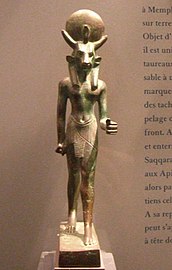
Statuette of anthropomorphic Apis
-

Bust of Sarapis.


Vegetation deity[modifying | change the code]
Osiris who presides over the grain[modify | change the code]

Ploughing scene illustrating chapter 110 of the Book of the Dead. Tomb of Sennedjem.
Foranthropologist James George Frazer,the gods Osiris, Dionysus, Attis and Adonis are spirits of vegetation. Osiris is like the grain buried during sowing that rises in the next harvest. The grain is fertilized by water in the soil and then, during harvest, it is dismembered by the sickles of the reapers75.
It is not yet established with certainty whether from the outset Osiris is a god of vegetation or if this side of its personality has subsequently grafted itself on its aspects of funeral god. The fertility of the Egyptian soil is related to the silt carried by the Nile flood to which Osiris is associated. Despite the cutting of Osiris’ body into pieces, his physical death is presented as a lethargy. This unconsciousness of Osiris is like that ofAtoum in the Noun (the primordial ocean) before the creation of the universe. The sleep of the god Osiris is contrary to the order established by the creator god. Nevertheless, his death is necessary for humanity to exceed its earthly limits and attain divine eternity. Osiris is the god who drowned in the waters of the Nile76. His long stay in the water is seen as a return to the chaos of the ocean of origins. But this ocean is the middle of which life springs. The dismemberment of Osiris into sixteen pieces is linked to the annual return of the Nile flood. The ideal height of the flood is sixteen elbows and, when this level is reached Osiris is reconstructed77.
“The Primordial of the Whole Double Country! food and food in front of theEnneade, Akh perfect among the akhou for whom the Noun spreads his water […] Plants grow according to his desire and for him the productive land constantly gives birth to food […] [Geb] put under his hand this country, its water and wind, its grass and all its herds, all that flies and everything that arises, its reptiles and animals of the desert, (all this) offered to the son of Nout: and the Double Country rejoices! […] what surrounds the solar disk is subject to its purposes; (likewise) the north wind, the river, the waves, the fruit tree and all that grows. It is Nepri who gives all its vegetation, the food of the soil. It establishes satiation and provides it to all countries. Every being is happy, all heart is joyful. »
— Great Anthem to Osiris. New Empire. Louvre Stele C28678
Khoak Month Festivities[change | change the code]

Osiris vegetating. Temple of Philo.
Originally developed in Abydos and Busiris, the khoak month festivities rite has won all the temples that are supposed to preserve a relic of the deposed Osirian body since the 11th dynasty.79.
The grain germination cycle was seen by the Egyptians as a metaphor for their conception of death. One of the images of Osiris’ rebirth is the figuration of grain spikes growing on his mummified body. This representation was actually implemented in the temples according to the ritual of the month of Khoiak. In a mummy-shapedvat, the priests placed an earthy mixture, where grain began to germinate (during underwater searches, a vat of this kind was found inside the temeros of the temple ofAmon and Khonsou of the sunken city of Heracleion). This vegetating Osiris, once placed in the sun and then dried out, was placed in a sacred boat and then transported to the necropolis of the city of Canope. This plant mummy was eliminated, either buried or thrown into the water80.
In the tombs, small mussels of this kind, called in the Egyptological medium “Osiris vegan” or “Osiris cereals” could be placed in the Egyptian medium.81.
Cult of Sacred Relics[modify | change the code]
Osiris in all his graves[modify | change the code]
The cult of Osiris spread throughout Egypt. However, several cities have distinguished themselves because of their special relationship to the myth of the dismemberment of Osiris. Traditions differ as to the number of Osirian members scattered throughout the country; fourteen to forty-two depending on the different versions. According to Plutarch,Seth drowned his brother Osiris by locking him in a chest thrown into the Nile. The remains drifted to Byblos (Lebanon)where it was found by Isis. The goddess brought the chest and body back to Egypt near Bouto. But during a game of hunting, Seth found Osiris’ body. Mad with rage, he dismembered the body into fourteen pieces and scattered them on all sides. Desperate, Isis set out to find them and went looking for them all over the country. Whenever she found a piece she entrusted the care of the local clergy so that Osiris’ memory would be honoured82.
In the first chapter of the Book of the Dead,the deceased presents himself as a priest of the cult of Osiris, hoping to benefit from the funeral rites inaugurated by the dismembered god. The deceased thus lists a few cities where, during his lifetime, he honoured Osiris. Participation in the rites of these sacred places helps to win the favor of the gods. In the afterlife, the gods take care only of those who have honored them. Participating in the rites related to the embalming of Osiris during his lifetime allows, once deceased, to be able to contemplate the god and survive in his kingdom83 :
“I am with Horusas protector of osiris’ left shoulder in Letopolis; I come and go, like a flame, on the day to drive the rebels out of Letopolis.
I am with Horus, on the day to celebrate the feasts of Osiris and prepare the offerings for Ra,the feast of the sixth day of the month and the feast-deni, in Heliopolis.
I am the priest-ouâb in Bousiris,and I exalt the One who is in the mound.
I am the prophet ofAbydos,the day the ground is high.
I’m the one who sees the mysteries in Ro-seétaou.
I am the one who reads the ceremonial of Aries that is in Mendes. »
— Excerpt from the chapter.1 of the book of the dead. Translation by Paul Barguet84
Phallus of Mendes[modifying | change the code]
| Banebdjed | ||||||
|
||||||
| bȝ-nb-ḏd |


Plutarch, in his version of the myth of Osiris reports that the goddess Isis found all the limbs scattered except the phallus eaten by fish. To replace him, she made an imitation of it85. However, the city of Mendes has retained another mythical tradition. The relic that is honored in this city is the phallus attached to the spine. These two limbs make only one relic because the Egyptians, (and the Greeks after them), thought that the bone marrow was coming down from the spine to the testicles and coming out through the phallus in the form of semen. The seed in the woman’s body then formed the child’s bones, the feminine moods forming the flesh86. Lately, the Jed pillar was likened to this relic, the city of Mendes bearing in egyptian language the name of Jedet or Perbanebdjedou; the god of Mendes being since the beginnings of Pharaonic Egypt the ram Banebdjedet87. The latter was considered thesoul-ba of Osiris. In fact, this animal carried in him four souls-ba, those of Ra, Shou, Geb and Osiris; so it was depicted with four ram heads88.
Philo and Biggeh’s Abaton[modify | change the code]

Crocodile Horus carries the mummy of Osiris out of the marshes towards Biggeh Abaton. Relief of Hadrian’s Gate in Philo.
For the Egyptians, the water from the Nile flood comes from the underground world and comes out of a cave in the region of the first cataract. This mythical spring was first located in Elephantine,the city of the ram god Khnoum89. Then, in the Lower Times,the source of the Nile was mostly assimilated to theAbaton of biggeh Island. The flood erupting from the wound inflicted by Seth on Osiris’ left leg preserved there. The cult for Osiris probably dates back to the 6th century from the reign of Psammetic II. Abaton is a word from ancient Greek: ἂβατον and means “unattainable.” The Egyptian names of the Abaton are Iat-ouâbet,“The Pure Square” and You-Ouâbet,“The Pure Island”. The Abaton is one of Osiris’ tombs. This sacred place is a necropolis where Isis found the left leg of his dismembered brother90. The cults of Osiris of the Abaton of Biggeh were intimately linked to those ofIsis of the island of Philo:
“It is also said that there is near Philo, a small island for everyone inaccessible; birds never fall into it, and the fish do not approach it. However, at a certain time, priests cross the water to make funeral sacrifices, to crown the tomb there and which is shaded by a plan of metthida whose height exceeds that of all olive trees. »
— On Isis and Osiris. Plutarch91.
The statue of the goddess went out in procession every ten days from her temple in Philo to go by boat to Biggeh. Through his priests, Isis performed ritual acts such as milk libations for Osiris; the goal is to revive its vigour. The rites are turned to the soul-Ba d’Osiris so that he unites with his body and awakens the mummy sleeping in theAbaton. In addition to these decadent rituals, the highlights of the year are the stays of Isis andHarendotes in the tomb on the thirteenth day of the month ofEpiphi and the regeneration rituals of the month of Khoiak92.
Magical threats against worship[change | change the code]
Towards the beginning of the 4th century AD, the neoplatonic Jamblique in his treatise on the Mysteries of Egypt explains to the opponents of theurgy the modus operandi of verbal threats against the cults and festivities rendered to Osiris and Isis93. According to him, the threats made by the magician are not intended for the gods (sun, moon, stars) but for lower spirits94. The latter, without judgment or reason, are content to obey the orders of their divine superiors. Verbal threats terrorize these minds. During a ceremony, a trained magician can easily fool them by introducing himself to them in the form of a superior deity.
In the 12th century, the tale of the Adventures of Horus and Seth ended with a mention of these inferior spirits. To succeed, Osiris threatens the other gods to send them against them. If Horus does not get the throne then a horde of hostile spirits will fall upon the earth and the living beings, gods and humans, will join the kingdom of theAfterthest95. The magic papyrus of Turin are dated from the same period96. A magic formula uses the verbal threat against the feasts and cults of the Osir. The purpose of the incantation is to heal a sick person because bewitched by an envoy of Osiris. Healing requires disenchantment. The magician-healer presents the thing in the form of a royal decree written by Osiris. The order forces the evil entity to leave the victim’s body. For this to happen, the magician frightens him by making dark threats to the Osirian cult. The proper functioning of the universe guaranteed by the cult given to Osiris can only continue on the condition of his departure from his victim97 :
“If we delay in driving out the enemy, the enemy, the dead, the dead, or anything terrible, then the enemy of heaven will divide the sky, the enemy of the earth will overthrow the earth, and Apophis will seize the boat for millions of years; the water will not be given to the one who is in the coffin, the one who is in Abydos,will not be buried, the one who is in Bousiris,will not be hidden, we will not perform rites for the one who is in Heliopolis,we will not present offerings to the gods in their temples, men will no longer present offerings to any god in any feast.
But if one hunts the dead and the dead, the enemy and the enemy, the male adversary and the female adversary, and the execrable things that are in this body […] then the sky will remain stable on its four pillars, the earth will remain in its position, the water will be given to the one who is in the coffin, the one who is in Abydos,will be buried, the one who is in Bousiris will be hidden, we will perform rites for the one who is in Heliopolis,we will present offerings to the gods in their temples, the men will present offerings to all the gods in all their feasts as soon as the dead, the dead, the enemy, the enemy, the male adversary, the female adversary will come out on the earth from the body of (name of the sick), son of (name of the sick). »
— Magic Papyrus of Turin (Excerpts)98
Osiris in the name of Abydos[modify | change the code]
Royal Necropolis[modifying | change the code]
Very oldly, the funeral god ofAbydos was the canid Khentamentiou “the one who presides over the Westerners (the deceased)”, revered since the end of the predynastic period99. Although the cult of Osiris settled in the city under the 5th Dynasty,it did not take off until the First Intermediate Period,which caused the merger of the two funerary deities during the 11th dynasty,when King Antef II brought Abydos under his authority. Osiris then completely supplanted Khentamentiou and the latter became a mere name of Osiris100. In the Middle Kingdom,the city ofAbydos established itself as the main place of Osirian worship. However, its heyday was during the 19th dynasty when the kings Sethi I and Ramses II undertook major works.
The prestige of the necropolis of Abydos is very old because it goes back very far in history; tombs or cenotaphs of the first Egyptian kings located there. Archaeological research has thus unearthed royal tombs dating back to the Egyptian Dynasty Zero (Scorpio I),but also of the two thinite dynasties(Iand IIdynasty). Subsequently, the royal necropolis was transferred further north to Memphis (Saqqarah). Abydos then became a semi-mythical place of the origins of royalty101. The tomb of King Djer,built around 3000 BC, was identified by the believers of the Middle Kingdom(a millennium later) as that of the god Osiris102. This tomb becomes a place of pilgrimage in the New Kingdom99.
-

Map of the necropolis of the thinite kings.
-

View of the necropolis ofUmm el-Qa’ab.
-
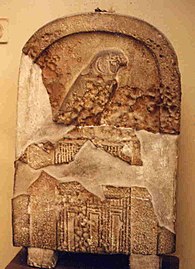
Stele of King Djer (Idynasty).


Osiris head[modify | change the code]
In the Middle Kingdom,the prestige of Abydos was due to the fact that the city was the custodian of an Osirian relic entrusted by the gods; the latter who found Osiris’ head not far from the necropolis:
“The 19th of the fourth month of spring was the day the head was found in the Western Gebel. Anubis, Thot and Isis had gone to the necropolis; a bird-qebeq and a wolf watched over her. Thot raised her head, and found under her a beetle. So he made her rest in the necropolis of Abydos to this day. We called Abydos the city of the beetle, because of it. As for the bird-qebeq, it is Horus, master of Letopolis. As for the wolf, it’s Anubis. »
— Papyrus Jumilhac. Translation by Jacques Vandier103

Abydos Reliquary. Relief of the temple of Sethi I, 19th Dynasty.
The relic is a sacred but fragile object. In fear of a possible Sethianattack, the relic is deposited and hidden in a reliquary. These can take different shapes, chest, obelisk, vase, animal skin. The relic of Abydos is contained in a basket perched on a pole:
“As for thereliquary-insout,it is a basket of reeds(n sout),that is to say of rush. The god’s head is wrapped in it. In other words, the reliquary is called “king”(nesout)because of the head (which is placed there) in a mysterious unknown chest. This one is a basket of braided (rushes), a shrine whose inside is unknown. The venerable head with a white crown is in it, made of paste, wrapped in gold. Its height is three fins, three fingers (28.2 cm). »
— Temple Wall of Denderah. Translation by Sylvie Cauville104
Abydean festivities[modifying | change the code]
The Egyptian temples were places closed to the secular public. The statue of the god remained hidden throughout the year in the naos (or saint of saints) of the religious building. However the god went out every year outside the temple. This outing was the pretext for a big party where during a few highlights, everyone could participate. In Abydos,this outing took place at the beginning of the year at the beginning of the flood season. The statue of the god Osiris carried in a boat left his temple to go with great pomp to his tomb located in a place called Ro-Peker. There, we commemorated his death and then his triumph over his enemies. After that, the statue returned to its temple105. The Osirian festivities of Abydos are inspired by the memphite royal funeral rituals of the time of the pyramids and celebrated for the deceased pharaohs of theOld Empire,transposed on the divine plane and repeated annually for Osiris106.

Sacred boat. Relief of the temple of Sethi I, 19th Dynasty.
Ikhernofret,on its stele preserved in Berlin,recounts the festive events that took place under his direction, during the 19th year of the reign of King Sésostris III. At the age of twenty-six, he was sent by royal order to Abydos. He must pay tribute to Osiris, filling him with gold after a victory of the king against the Nubians. Before participating in the Osirian celebrations playing the role ofHorus,Ikhernofret renovated the boat Neshmet,had statues fashioned and had their chapels rebuilt107. The festivities take place in four acts:
- The procession ofOupouaout,the Path Opener. The deity here is a manifestation ofHorus who fights in the name of his father Osiris against his Sethian enemies. Enemies are symbolically crushed in a magical ritual where wax statuettes and vases are manhandled and then destroyed108.
“I “played” the exit of the “Walker”” when he came forward to avenge his father; I hunted the enemies of the boat Neshmet, I repelled the enemies of Osiris. I then “played” a big exit, while Thot straight directed the navigation. »
— Stele of Ikhernofret. Translation by Claire Lalouette109
- The procession of the boat Neshmet. This is the great procession of the funeral of the god Osiris. The statue of the god, in his boat, leaves the temple towards the necropolis. This sacred ritual is so great that even the deceased wish to take part. The magic formula 138 of the Book of the Dead allows you to attend post-mortem110.
“I had equipped with a beautiful chapel the boat (called) “The one who appears in glory thanks to the Truth-Justice,” and, having fixed his beautiful crowns, here is the god who walks towards Peker, I cleansed the path that leads to his tomb facing Peker.”
— Stele of Ikhernofret. Translation by Claire Lalouette109
- Haker’s party, the night of Horus the fighter. This night corresponds in the funeral worship to the night of justification where the judgment of the dead is ritualized during night vigils111.
“I avenged Ounennefer (Osiris) on this famous day of the Great Fight, and I defeated all his enemies on the shore of Nedyt.”
— Stele of Ikhernofret. Translation by Claire Lalouette109
- The procession to the temple of Osiris. This is the last act of the feast with the triumphant return of the statue of the god Osiris to his temple, justified and resurrected112.
“I made sure that he went inside the boat (called) “the Great” and that it bore its beauty. I rejoiced in the hills of the western desert, and created exultation in these hills, when “they” saw the beauty of the boat Neshmet, while I approached Abydos, (the boat) who brought Osiris, lord of the city, back to his palace. I followed the god into his house, made him cleanse himself and join his throne… »
— Stele of Ikhernofret. Translation by Claire Lalouette109
Votive steles[modify | change the code]
In the Middle Kingdom, King Sésostris III of the 12th dynasty encouraged the worship of Osiris in Abydos by renewing the religious material, building a temple of Osiris and for himself a pyramidal burial complex113. At the same time, a large number of wealthy individuals, motivated by their piety towards Osiris, had chapels builton the “Terrace of the Great God” near the temple of Osiris. These buildings are built of raw bricks and are surrounded by a rectangular enclosure. Some chapels had a vaulted room where the statue of the deceased was housed with votive steles embedded in the interior walls. Others were full with stelae attached to the exterior walls. The focal point of these buildings were therefore steles celebrating the memory of the deceased and his family114. These archaeological pieces are now scattered in museums around the world. In 1973, 1,120 steles from the 6th to the 14th dynasty were inventoried; 961 of them invoke Osiris115. At the end of the 12th and then during the 13th dynasty these steles were no longer a privilege for high-ranking officials. People of modest means lay stelae in smaller chapels where they are placed in a monument of a more affluent individual. The stele of the harpist Neferhotep was thus deposited by his friend Nebsoumenou, a brick-bearer, in the chapel of Iki, superior of the priests116. This funeral practice continued in the New Kingdom and during the Lower Period.
-

Stele of Nemtyemhat and his wife, 11th Dynasty, National Museum of Alexandria.
-

Stele of Iméniséneb, team controller in Abydos, XIII or 14th Dynasty, Louvre Museum.
-

Stele of Queen Noubkhas XIIIdynasty , Louvre Museum
-
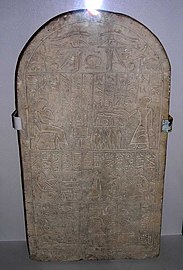
Stele of Horiouah, XIII dynasty, Roanne.
-
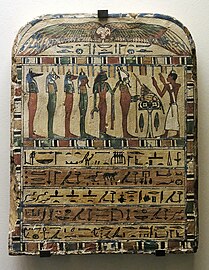
Irethorrou made an offering to Osiris, followed by Isis and the four sons of Horus: Amset, Hâpi, Kebehsinouf and Douamoutef, XXVe Dynasty, Louvre Museum.


Appendixes[modify | change the code]
Bibliography[modify | change the code]
Dictionaries[edit | change the code]
- Collective, Dictionary of Mythologies, Paris, Flammarion, 1999 (ISBN 2-7028-2882-5)
- Maurizio Damiano-Appia (translation of Italian), Encyclopedic Dictionary of Ancient Egypt and Nubian Civilizations,Paris, Grund, 1999, 295 pp. (ISBN 2-7000-2143-6)
- Isabelle Franco, New Dictionary of Egyptian Mythology,Paris, Pygmalion, 1999,319 p. (ISBN 2-85704-583-2)
- Guy Rachet, Dictionary of Egyptian Civilization, Paris, Larousse-Bordas, 1998, 268 p. (ISBN 2-7028-1558-8)
- Pascal Vernus and Jean Yoyotte, Dictionary of the Pharaohs, Paris, Noêsis Editions, 1998, 226 pp. [details of editions] ( ISBN 2-7028-2001-8)
Hieroglyphics[modify | change the code]
- (from) Jurgen Zeidler, “Zur Etymology of the Gottesnamens Osiris” , Studien zur Alt-gyptischen Kultur, Helmut Buske Verlag GmbH, vol. 28, 2000, p. 309-316 (JSTOR 25152830)
General[change | change the code]
- British Museum, The Book of Ancient Egypt, Paris, Editions du Félin, 1995
- Françoise Dunand and Christiane Zivie-Coche, Men and Gods in Egypt, Paris, Cybele Editions, 2006, 491 p. (ISBN 2-915840-02-4)
- Isabelle Franco, Myths and Gods. The Breath of the Sun, Paris, Pygmalion, 1996, 279 pp. (ISBN 2-85704-476-3)
- Florence Maruéjol, Ancient Egypt: Mysteries of the Pharaohs and Daily Life,Paris, Chronicle Editions, 2011,161 p. (ISBN 978-2-918978-09-1)
- Béatrix Midant-Reynes, The Origins of Egypt: From the Neolithic to the Emergence of the State, Paris, Fayard, 2003, 441 p. (ISBN 2-7028-8447-4)
- Pierre Tallet, Sésostris III and the end of the 12th Dynasty,Paris, Pygmalion, 2005 (ISBN 2-85704-851-3)
Translations[modify | change the code]
- Paul Barguet, Texts of the Egyptian Sarcophagi of the Middle Empire, Paris, Le Cerf, 1986, 725 p. (ISBN 2-204-02332-9)
- Paul Barguet, The Book of the Dead of the Ancient Egyptians,Paris, Editions du Cerf, 1967 (ISBN 2-204-01354-4)
- André Barucq and François Daumas, Hymns and Prayers of Ancient Egypt,Paris, Le Cerf, 1980,559 pp. (ISBN 2-204-01337-4)
- Claude Carrier, Texts of the Pyramids of Ancient Egypt, Paris, Cybele, 2009-2010, 417 pp. (ISBN 978-2-915840-10-0)
- Jamblique (translation of ancient Greek), The Mysteries of Egypt, Paris, The Beautiful Letters, 1993, 237 pp. (ISBN 2-251-47001-8)
- Dimitri Meeks, Myths and Legends of the Delta: After the Brooklyn Papyrus 47.218.84, Cairo, IFAO, 2008(2nd ed.), 498 pp. (ISBN 978-2-7247-0427-3)
- Claire Lalouette, Sacred Texts and Secular Texts of Ancient Egypt: Myths, Tales and Poetry,Paris, Gallimard, 1994, 345 pp. (ISBN 2-07-071176-5)
- Plutarch (trad. of ancient Greek by Mario Meunier), Isis and Osiris, Paris, Guy Trédaniel Publisher, 2001, 236 pp. (ISBN 2-85707-045-4)
- Guy Rachet, The Book of the Dead of the Ancient Egyptians: text and vignettes of the papyrus of Ani, Monaco, Editions du Rocher, 1996, 258 p. (ISBN 2-268-02190-4)
- Alessandro Roccati, Historical Literature Under the Old Egyptian Empire, Paris, Le Cerf, 1982 (ISBN 2-204-01895-3)
- Pascal Vernus, Wisdoms of Pharaonic Egypt, Paris, National Printing Editions, 2001, 414 pp. (ISBN 2-7433-0332-8)
Cults and Beliefs[modifying | change the code]
- Hartwig Altenmuller, “The Master of the Tomb as Horus Son of Osiris: Reflections on the meaning of the wall decoration of the tombs of the Old Empire in Egypt (2500-2100 BC. J.-C.), “ANKH,” nos 4/5, 1995-1996, p. 196-213 (read online [archive]).
- Jan Assmann, Maât, Pharaonic Egypt and the Idea of Social Justice,Fuveau, The House of Life Editions, 1999,173 pp. (ISBN 2-909816-34-6).
- Jan Assmann, Death and Beyond in Ancient Egypt,Monaco, Editions of the Rock, 2001.
- Marie-Astrid Calmettes, “The Last Scene of the Book of Doors,” Egypt, Africa and the East, No. 39, Avignon, 2005, p. 47-58 (ISSN 1276-9223).
- Emile Chassinat, The Mystery of Osiris in the Month of Khoiak, Cairo, IFAO, 1966, 834 pp. [ detail ofeditions].
- Laurent Coulon, “The Relics of Osiris in Ancient Egypt,” Studia Religiosa Helvetica Jahrbuch, Bern, 2005 (ISBN 3039105922, read online [ archive].
- Didier Devauchelle, “Osiris, Apis, Sarapis and others. Notes on the Osiris memphites in the 1st millennium . BiEtud 153 (IFAO), 2010, p. 49-62.
- Françoise Dunand, Isis, mother of the gods, Paris, Errance, 2000.
- Annie Forgeau, Horus-son-of Isis. The Youth of a God,Cairo, IFAO, 2010 (ISBN 978-2-7247-0517-1).
- Erik Hornung, The Gods of Egypt. The One and the Multiple, Paris, The Rock, 1986, 309 pp. (ISBN 2-268-01893-8).
- Erik Hornung, The Texts of the Afterlife in Ancient Egypt, Paris, The Rock, 2007 (ISBN 978-2-268-06344-7).
- Christian Jacq, The Journey to the Other World according to Ancient Egypt, Paris, The Rock, 1986, 673 p. (ISBN 2-7028-1258-9).
- Jamblique (translation of ancient Greek), The Mysteries of Egypt,Paris, The Beautiful Letters, 1993,237 pp. (ISBN 2-251-47001-8).
- Holger Kockelmann, “Abaton, Tomb and Place of Worship on the First Cataract,” Egypt, Africa and the East No. 60, Avignon, 2010/2011, p. 31-44 (ISSN 1276-9223).
- François Lexa, The Magic in Ancient Egypt,Paris, Orientalist Bookstore Paul Geuthner, 1924.
- Bernard Mathieu, “But who is Osiris? Or politics under the shroud of religion,” ENIM 3, Montpellier, 2010, p. 77-107 (read online [archive]).
- Dimitri Meeks, Myths and Legends of the Delta: After the Brooklyn papyrus 47.218.84, Cairo, IFAO, 2008, 498 pp. (ISBN 978-2-7247-0427-3).
- International Roundtable-Lyon-2005, The Cult of Osiris in the 1st Millennium BC, Vol. BiEtud 153, Cairo, Laurent Coulon-IFAO, 2010 (ISBN 978-2-7247-0571-3).
- Alexandre Varille, “The Stele of the Mystical Beky (No. 156 of the Turin Museum) [with 1 plank]. “, BIFAO 54, Cairo, 1954, p. 129-135 (read online [archive]).
- Youri Volokhine, “Ritual Sadness and Funeral Lamentations in Ancient Egypt,” Journal of the History of Religions, 2008, p. 163-197 (read online [archive]).
- Henri Wild, “Statue of a Noble Mendesian of the reign of Psammetic Iat the museums of Palermo and Cairo [with five plates]. “, BIFAO 60, Cairo, 1960, p. 43-67 (read online [archive].
- Jean Yoyotte, “The bones and the male seed. About an Egyptian physiological theory. BIFAO 61, Cairo, 1962, p. 143-146 (read online [archive].
- Jean Yoyotte, “A Biographical Note of King Osiris,” BIFAO 77, Cairo, 1977, p. 145-149 (read online [archive]).
- Jean Yoyotte, “Osiris in the Alexandria Region,” BiEtud 153 (IFAO), 2010, p. 36-37.
Egyptological reviews[modifying | change the code]
- Bulletin of the French Institute of Oriental Archaeology, Cairo, IFAO
Notes and references[change | change the code]
Notes[change | change the code]
References[change | change the code]
- J. D. Fage, Roland Anthony Oliver, The Cambridge History of Africa, Vol. 2, Cambridge University Press, 1975, 886 pp. (ISBN 978-0-521-21592-3,online presentation [ archive])
- 2010, p. 79: The origins of Osiris
- 2010
- 2010, p. 17
- 2010, p. 77,
Roccati 1982, p. 105-107 - 2010, p. 91
- 2010, p. 97
- 2010, 78
- 2010, 79-80
- 2010, 88-92
- Damiano-Appia 1999, 74
- Damiano-Appia 1999, 50
- Maruéjol 2011, p. 49
- Damiano-Appia 1999, 258
- Damiano-Appia 1999, 207
- Damiano-Appia 1999, 152
- 1998, 192-193
- 1996, 13-17
- 1967, p. 170
- 1967, 186-188
- Plutarch, 52-55
- 2009-2010, Tome I, p. 79-81: Spruch 219, 167a-171d .
- 1986, 463-474: Spell 75 to 83
- 2009-2010, Tome I, p. 81-83: Spruch 219, 172a-176c .
- Dunand 2000
- Barucq and Daumas 1980, 94-93. Translation of the Great Anthem to Osiris: Alexandre Moret, “The Legend of Osiris in the Theban era after the Hymn to Osiris of the Louvre”, Cairo, BIFAO, Vol. 30 (1931), p. 725-750.
- Plutarch, 61: 14, p. 179: 59 and p. 141: 44 .
- Meeks 2008, 17
- Meeks 2008, 227
- Plutarch, p. 171: 44 .
- Meeks 2008, 229
- Barucq and Daumas 1980, 93-94
- Yoyotte 1977, 145-149
- 1967, p. 162
- Plutarch, p. 56: 13 .
- 2010, 82 and p.85-87.
- 1999, 32-34.
- 1999, 37 to 42.
- 1999, 42 to 51.
- 1999, 52 to 56.
- Dunand and Zivie-Coche 2006, 86.
- Vernus and Yoyotte 1998, 49.
- 2010, 86.
- Vernus 2001, 78.
- 2009-2010, Volume VI: Appendix C: Current State of Parallel Texts, Spruch 670, 4342-4343
- 2009-2010, Tome II, p. 489-491:Spruch 670, 1972-1978d .
- 2009-2010, Tome II, p. 491-493:Spruch 670, 1979a-1986b .
- Plutarch, 69-72: 18., and Maruéjol 2011, p. 46-47.
- Damiano-Appia 1999, 96
- 1967, p. 224.
- 1999, p. 202
- Damiano-Appia 1999, 98
- 2007, 63, 67, 92 and 104.
- 2005, p. 48
- 2005, 48-49 and 52
- 1986, 143-147
- 1986, 147-149
- 1967, p. 261
- 1986, 245-246, 278 . Orion, Sa
- 1986, 493-500
- 1986, p. 545
- 2010, p. 45
- 2010, p. 46
- 2010, 46-48
- 1994, Tome II, p. 282, note 117
- 1994, Tome II, p. 92-102.
- Lalouette 1994, Tome II, p. 102-103.
- 2001, 130-131
- Roccati 1982, 144-145
- 2001, 133-134
- 2001, p. 134,
Varille 1954, p. 129-135 - Devauchelle 2010, 49-62
- Dunand and Zivie-Coche 2006, p. 286
- Dunand and Zivie-Coche 2006, p. 287
- Plutarch, p. 189-191: 65 and note 1 p. 191.
- 1996, p. 193
- 1996, p. 195
- Barucq and Daumas 1980, 92, 94 and 96
- Maruéjol 2011, p. 48
- Yoyotte 2010, 36-37
- 1996, p. 204-206
- Plutarch, 69-72: .18
- 2001, 314-315
- 1967, 38-39
- Plutarch, 71-72: 18
- Yoyotte 1962, 143-146
- 1960, 43-67
- Meeks 2008, 262-265
- Assmann 2001, p. 514-529.
- Kockelmann 2010/2011, p. 31-32.
- Plutarque, p. 78 : §.20.
- Kockelmann 2010/2011, p. 33-34.
- Jamblique, p. 174-177 : Chap. VI, 5-7.
- Jamblique, p. 127-128 : Chap. IV, 1.
- 1994, Tome II, p. 102-103
- Lexa 1924, Tome II, p. 45
- Lexa 1924, Tome II, p. 49-50, IV.—120/5-122/10
- Lexa 1924, Adapted translation from Tome II, p. 49-50, IV.—120/5-122/10.
- Maruéjol 2011, p. 47
- Dunand and Zivie-Coche 2006, p. 257
- 2001, 450
- Museum 1995, 68
- 2005, p. 27: quote
- 2005, p. 31: quote from Cauville, Dendera X.36, 12-15.
- Dunand and Zivie-Coche 2006, p. 163
- 2001, 350
- 1994, Tome I, p. 173-175
- 2001, 347
- Lalouette 1994, Tome I, p. 175
- 2001, 348
- 2001, 348-349
- 2001, 349
- 2005, 90-98 and 240-246
- 2005, 216 and 218
- 2010, p. 104
- 2005, 217 and 219
See also[change | change the code]
Related Articles[modify | change the code]
- The Judgment of the Soul of Osiris
- Myth of Osiris
- Egyptian Astrology
- Exoplanet Osiris
- Collection of Egyptian antiquities from the Museum of Fine Arts in Lyon
External links[change | change the code]
- Portal of Egyptian Mythology Portal of Death

